
Most owner-led businesses can tell you what their website cost. Far fewer can say, with evidence, which person or company is the registrant of the domain, who can change the DNS, which email address receives the renewal warnings, and who would approve a transfer if the original developer stopped replying.
That gap stays invisible until something changes: an agency relationship ends, a manager leaves, the business opens a second entity in the Gulf or India, or a renewal fails on a card nobody uses any more. Then a simple website task becomes a lockout.
Direct Answer
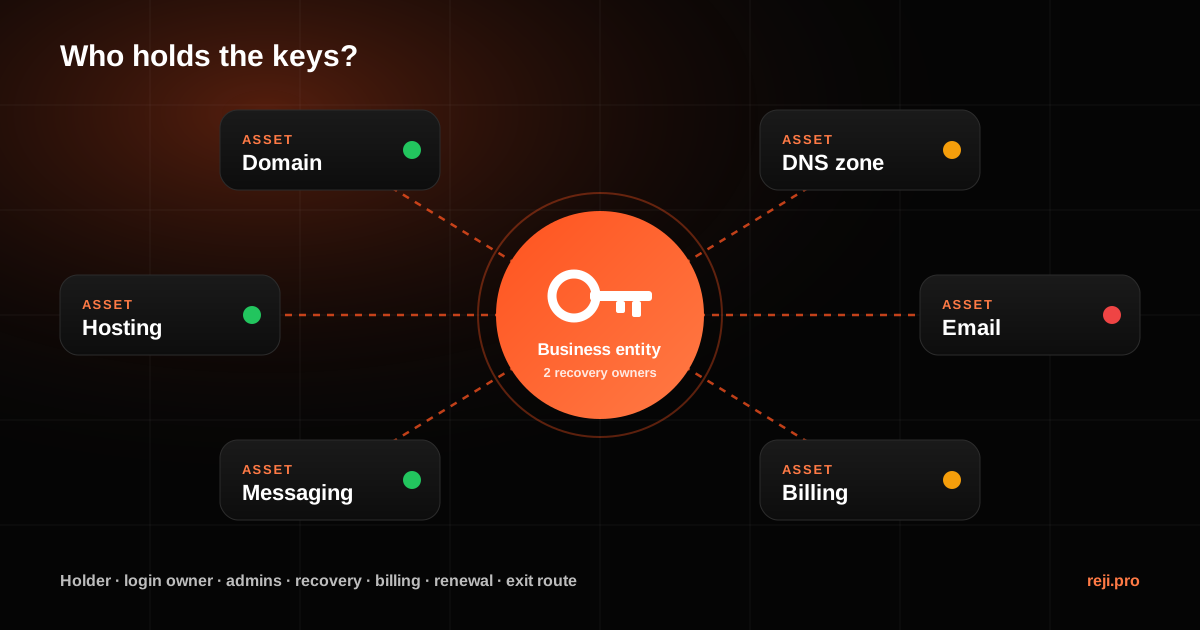
A digital asset ownership audit is a short, written check of who legally holds and who operationally controls every account the business depends on online: domain, DNS, hosting, code, backups, business email, messaging, analytics, search, ads and payment accounts. For each one, record the legal holder, the account login owner, the people with admin access, the recovery email and phone, the billing method, the renewal date and the documented exit route. The goal is simple: the business entity, not an individual or a supplier, should hold every critical asset, with at least two named people able to recover it.
Why Ownership Gaps Hurt More Across Borders
Cross-border businesses collect ownership gaps faster than single-market ones. A founder in Bahrain may have had the first website built by a freelancer in Kerala. The domain might be registered in the freelancer's name, the DNS might sit in an agency's CDN account, the hosting might be billed to a personal Indian card, and the support inbox might be a mailbox that a former employee set up.
Each decision made sense at the time. Together, they leave the business without the keys to its own front door.
In hosting and domain support work, the pattern repeats in a predictable way. The problem is rarely a technical failure. It is a missing answer to "who is allowed to approve this?" at the moment a renewal, transfer or migration needs a decision.
The Digital Asset Ownership Register
Use one row per asset. If a field is blank, or the answer is a person who no longer works with you, mark the row red.
- Asset and purpose, for example the primary .com domain used for the website and email
- Legal holder: the registrant or account holder named by the provider
- Business entity that should hold it, and in which country
- Login owner and the email address used to sign in
- Admin users, with their role and whether they still work with the business
- Recovery email, recovery phone and where multi-factor codes are delivered
- Billing method, card holder and invoice recipient
- Renewal or expiry date and auto-renew status
- Dependencies: what breaks if this asset stops (website, email, payments, ads, logins)
- Exit route: how the asset would be transferred, exported or rebuilt
- Evidence: screenshot or export date, reviewer and next review date
Keep the register outside the systems it describes. If the only copy sits in the mailbox you are trying to recover, it will not help during a lockout.
1. Start With the Domain Name
The domain sits underneath the website, the email, many verification records and often the payment pages. Check three separate things: who the registrant is, which registrar account manages the domain, and which email address receives registrar notices.
Public registration data for many domains is now redacted, so the reliable source is the registrar account itself. Look at the registrant contact, not just the account name. An account opened by the business can still contain a domain registered in a developer's name, and the reverse also happens.
For generic domains such as .com, ICANN's Transfer Policy names the registered name holder as the only party with authority to approve or deny a transfer to another registrar. Country-code domains such as .in, .ae or .bh follow their own registry rules, so check the relevant registry's policy rather than assuming the .com process applies.
Also check the timing. Registrars can apply temporary transfer locks after certain registrant changes, and ICANN's transfer rules have been under revision, so confirm the current timing with your registrar before a deadline depends on it. Plan registrant corrections well before a migration, a renewal or a launch.
2. Separate DNS Control From the Domain
DNS is often hosted somewhere other than the registrar: a hosting control panel, a CDN or a security service. Whoever controls the DNS can redirect the website, reroute email and add verification records for other services.
Record where the authoritative nameservers point, which account holds that DNS zone, and who has edit rights. Export the zone file or keep a dated copy of all records.
3. Hosting, Code and Backups
For hosting, ask the same ownership questions: whose account is it, who pays for it, and who can log in. Then go one level deeper.
- Where does the source code live, and does the business have its own copy or repository access?
- Where are backups stored, how often are they taken, and has anyone restored one recently?
- Are themes, plugins or licences registered to the business or to the developer?
- Which server or panel credentials exist only in one person's password manager?
A website the business cannot restore without one specific supplier is a dependency, not an asset. That is not a reason to drop good suppliers; it is a reason to make the handover route explicit.
4. Business Email and the Recovery Loop
Email is the master key for most other accounts, because password resets go there. Two traps come up again and again.
The first is a critical account that recovers to a personal Gmail address or to someone who has left. The second is circular recovery: the registrar account recovers to an address on the same domain it manages. If that domain expires or its DNS breaks, the email that would fix it stops arriving.
Give registrar, DNS and hosting accounts a recovery route that does not depend on the domain they control, and make sure multi-factor codes reach at least two people who still work with the business.
5. Messaging, Search, Analytics and Ads Accounts
Gulf and India businesses often depend on WhatsApp Business, Google Business Profile, Search Console, analytics, ad accounts and social business portfolios as much as on the website itself. Most of these platforms separate an owner or admin role from everyday user roles.
For each one, confirm that the business holds the highest role through a business-controlled login, that at least two current people hold it, and that agencies are added as users or partners rather than as the only owner. When an agency relationship ends, removing their access should be a routine step, not a negotiation.
6. Payments, Cards and Renewal Notices
Many lockouts start with a failed renewal rather than a dispute. A card expires, the invoice goes to an old mailbox, and nobody sees the warnings.
Move recurring digital costs to a business payment method where possible, send invoices to a shared finance or operations address, and keep the renewal dates in the register. Also note which entity is invoiced, because that helps show ownership later.
7. Turn the Audit Into a Handover Clause
The register is most useful before you hire the next supplier. Add a short ownership clause to every website, hosting or marketing engagement:
- Domains, accounts and profiles are registered to the business entity.
- The supplier receives the minimum access needed, under named user accounts.
- Code, content, design files and backups are delivered to, or accessible by, the business.
- At the end of the engagement, the supplier hands back access and confirms removal of their own access within an agreed time.
This is an operating safeguard, not legal advice. For contracts, disputes or intellectual property questions, take current advice from a qualified professional in the relevant country.
If Someone Else Already Controls a Critical Asset
Keep everything in writing. Ask the current holder to update the registrant or transfer the account, and give a clear, reasonable deadline. Keep the invoices and payment records that show the business paid for the asset.
Make sure the domain does not expire while the conversation continues. Contact the registrar or platform support through their official channels to understand what proof they accept. If the matter becomes a dispute, get qualified advice before escalating.
A Practical First Pass
Start small. In one working session, list the five assets the business cannot operate without, usually the domain, DNS, hosting, primary email and the main customer messaging account. Fill the register for those five, mark every red row, and fix the easiest one the same day, which is often a recovery email or a renewal card.
Then repeat a short review each quarter and after every supplier or staff change. Ownership drifts quietly, and a written check is the cheapest way to notice.
How Reji.pro Can Help
Reji.pro works with owner-led businesses in the Gulf, India and other markets on practical digital transformation decisions, including ownership, access and vendor-exit planning before new software or a migration is chosen. The first step is a diagnosis of the actual situation; implementation, migration and managed services are scoped separately when needed. The audit-before-software guide and the owner-led roadmap linked below show how this fits the wider sequence.
Sources
ICANN, Transfer Policy: icann.org/en/contracted-parties/accredited-registrars/resources/domain-name-transfers/policy
ICANN, Registrants' Benefits and Responsibilities: icann.org/resources/pages/benefits-2013-09-16-en
ICANN, FAQs for Registrants, Transferring Your Domain Name: icann.org/resources/pages/name-holder-faqs-2017-10-10-en
Frequently Asked Questions
Who owns my domain if an agency registered it?
Providers generally treat the person or organisation recorded as the registrant as the holder. For generic domains, ICANN's Transfer Policy gives the registered name holder the authority to approve transfers. If the agency is recorded as the registrant, ask them in writing to update it to your business, and take qualified advice if they refuse.
How often should a business review digital asset ownership?
Do a full review at least once a year, a short check each quarter, and an immediate review whenever a supplier, agency or staff member with admin access changes.
Should the founder be the only owner of every account?
No. The business entity should hold the asset, and at least two current, trusted people should be able to recover it. A single owner is a single point of failure, even when that owner is the founder.
Is a digital asset ownership audit only for large companies?
No. Small and owner-led businesses usually have fewer people and fewer written processes, so one missing login or expired card can stop the website, email and customer messages at the same time.
Global Malayali digital transformation consultant and mentor with 25+ years across web technology, SaaS, hosting, automation, infrastructure, and customer operations. Founder of Hostao, AutoChat, RatingE, and BestEmail.
Have one business workflow that needs to improve?
Describe the customer, operations, or team-workflow problem first. The next step may be diagnosis, mentorship, a focused implementation scope, or another specialist.